


Beyond the Window – When a Studio Becomes Reality

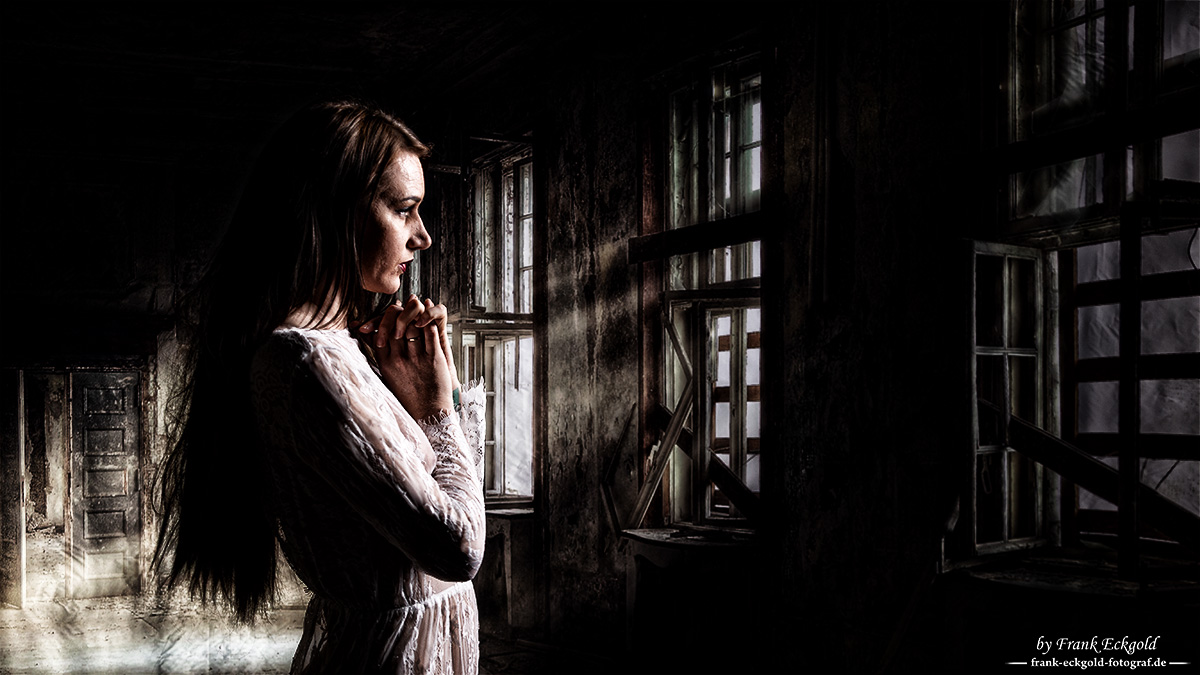
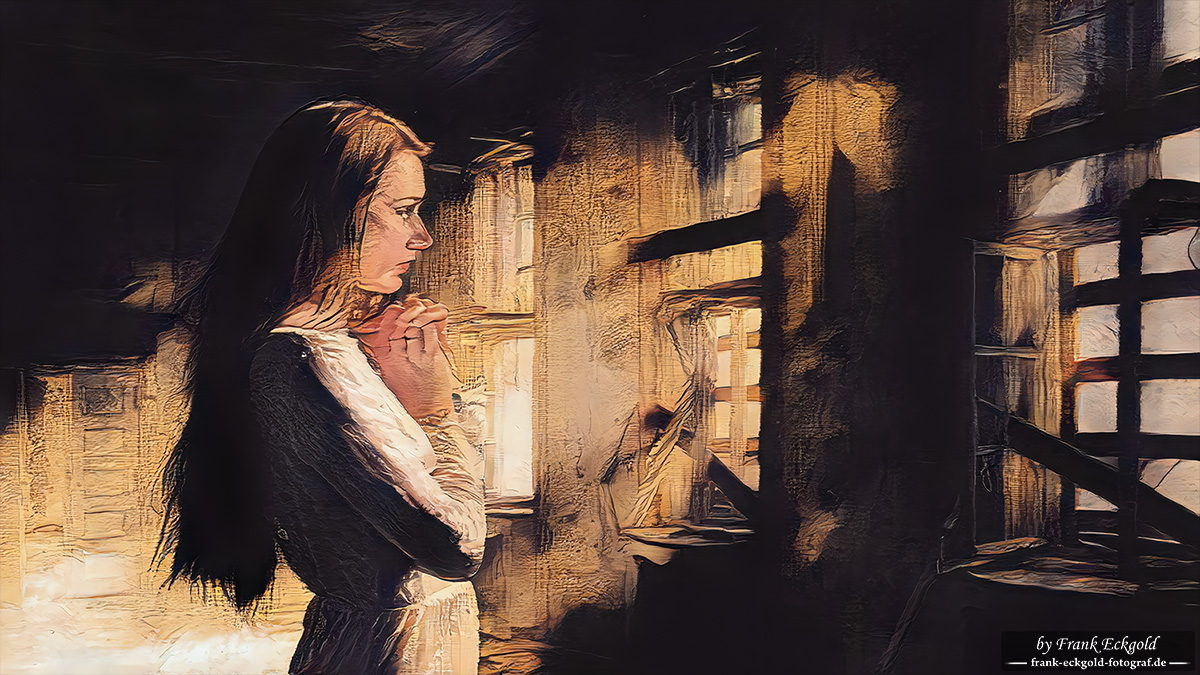
An abandoned location? Not quite! "Beyond the Window" was photographed in a studio using a printed canvas backdrop. Perspective, framing, lighting and carefully chosen image development created a convincing illusion. The later Painterly interpretation transforms the dark atmosphere into a warm, sunlit scene.
18. October 2026
Not everything that looks like a real location in a photograph was actually photographed there. Sometimes, the most convincing illusion is created in the last place you might expect: a photography studio.
"Beyond the Window" is one of those images. At first glance, the photograph appears to have been taken inside an abandoned building. Old windows, weathered walls and a dark, almost mysterious atmosphere provide the setting for a young woman standing thoughtfully by a window.
But this room never existed in the way the photograph suggests.
A Location That Isn't Really There
The entire architectural setting in the background is actually a printed canvas backdrop that I used for this studio photograph.
Backdrops like these offer fascinating creative possibilities. They allow us to create the impression of places without ever having to visit them. However, the illusion only works when the background becomes a believable part of the overall composition.
A printed canvas alone is not enough.
Simply placing it behind a model and lighting the scene without considering the surroundings often produces exactly what it is: a studio photograph with a backdrop.
Only through the careful interaction of several visual elements can we create the impression that the person in the photograph is genuinely standing within the depicted environment.
Three Essential Elements
For several years, this particular challenge was one of the central subjects of my studio photography workshops.
My approach focused on three essential elements: perspective, framing and lighting.
Perspective determines whether the spatial relationships appear convincing. Framing defines how much of the apparent surroundings becomes visible and whether those elements form a coherent composition.
Lighting, however, is particularly important.
If the lighting on the model does not correspond to the apparent lighting conditions of the background, the illusion quickly falls apart. The direction of light, the distribution of brightness and the shadows must work together so that foreground and background appear to belong to the same environment.
These were precisely the relationships I taught participants to recognise and apply during my studio workshops.
My aim was not simply to help them produce technically accomplished photographs. I wanted them to understand how a backdrop could become an integral part of a visual concept, allowing them to create images that would not immediately reveal their studio origins.
When a Canvas Becomes a Room
In "Beyond the Window", these elements come together.
The chosen perspective makes the windows and architectural structures appear spatially convincing. The framing concentrates on the essential elements of the scene, avoiding distracting clues about the actual shooting environment.
The lighting connects the model to her apparent surroundings.
The young woman stands by the window in a contemplative pose. Light draws attention to her face and hands, while much of the environment disappears into deep shadows.
This restrained lighting supports the illusion of an old room illuminated by only a small amount of available light.
The result feels more like an atmospheric photograph taken inside an abandoned building than a carefully controlled studio composition.
The Final Step Towards a Photographic Illusion
Yet even a carefully chosen perspective, convincing framing and appropriate lighting do not automatically guarantee that such an image will achieve its full effect.
Another important element is the final photographic development.
Especially when working with printed studio backdrops, the style of the image processing can determine whether the foreground and background are perceived as one coherent scene.
For "Beyond the Window", I deliberately chose a dark, contrast-rich visual approach.
The subdued colours, pronounced shadows and emphasis on selected areas of light give the photograph a sombre, almost timeless atmosphere.
At the same time, this treatment reinforces the impression that the model is genuinely standing inside the depicted room.
The final image development therefore became the last creative step in transforming a staged studio photograph into a convincing photographic illusion.
Another Reality Beyond the Window
To me, "Beyond the Window" demonstrates particularly well that photography does not necessarily have to document a place that actually exists.
It can create a reality of its own.
What initially appears to be a photograph taken inside an old building is, in fact, the result of deliberate photographic design.
But the story of this image did not end there.
When I later began exploring a Painterly interpretation, I did not want to simply reproduce the atmosphere of the original photograph. Instead, I developed the idea of deliberately reversing its dark lighting mood.
The pale light would become bright sunshine. And a cold, seemingly abandoned room would turn into a scene filled with warmth.
When Pale Light Becomes Sunshine
For the Painterly interpretation of "Beyond the Window", I wanted to create a deliberate contrast with the original photograph.
While the original is defined by darkness, restrained colours and an almost oppressive atmosphere, the artistic interpretation was intended to reveal a brighter, warmer side of the very same scene.
The central idea was light.
The pale illumination of the original image became warm, bright sunshine, seemingly streaming through the old windows into the room.
This changes more than the brightness of the image. It also transforms the emotional impact of the entire scene.
A New Atmosphere Within the Same Room
In the original photograph, the windows seem to open onto a cold, uncertain world outside. The dark walls and deep shadows give the room an abandoned and mysterious quality.
In the Painterly version, however, sunlight seems to reclaim the space.
Warm shades of gold, ochre and brown spread across the walls. The windows become luminous sources of light, bathing the surroundings in a gentle, almost nostalgic atmosphere.
The original architecture remains recognisable, but its emotional character changes completely.
What previously appeared dark and cold now feels warmer, more alive and more inviting.
When the Canvas Loses Its Boundaries
One particularly interesting aspect of this Painterly interpretation is that I was able to approach the lighting more freely than in the original photographic treatment.
With studio photographs featuring printed backdrops, there is often a risk that making the image too bright will weaken the illusion of a real environment.
Yet "Beyond the Window" demonstrated that the background could retain much of its spatial credibility even in a significantly brighter interpretation.
The windows, weathered walls and architectural structures still appear to belong to one coherent room.
This allowed me to transform the lighting mood without losing the original visual concept.
A carefully staged studio photograph became a painterly scene with its own sense of space and atmosphere.
Between Reality and Painting
Stylistically, the Painterly interpretation moves between Impressionist influences and an expressive visual language inspired by Post-Impressionism.
The surfaces lose some of their photographic precision and become visible painterly textures.
Light and colour take on a stronger creative role. The windows and walls appear less like precisely rendered architectural elements and more like parts of an atmospheric composition.
The model's pose remains unchanged.
Her lowered gaze, hands brought together near her face and quiet body language preserve a contemplative mood in the Painterly version.
But while this pose is surrounded by darkness and a certain heaviness in the original photograph, the warm light gives it a different emotional meaning.
For me, a moment of melancholy becomes something closer to quiet reflection and inner peace.
Two Lighting Moods, Two Stories
The direct comparison reveals just how profoundly lighting can influence the way we perceive an image.
The original photograph tells the story of a dark, seemingly abandoned room and a solitary person lost in thought.
The Painterly interpretation presents the same scene, but literally places it in a different light.
The warm colours soften the heaviness of the surroundings. The room feels more open, and the scene takes on an almost hopeful atmosphere.
The model, the windows and the composition remain the same. Yet the transformed lighting creates a different story.
An Illusion That Continues to Evolve
Whenever I look at "Beyond the Window" today, I first think of the many studio workshops in which I showed participants how to integrate printed backdrops convincingly into photographic compositions.
For me, the photograph therefore also represents the creative importance of perspective, framing and lighting.
It demonstrates how a simple canvas can become a believable photographic environment.
The later Painterly interpretation introduced another dimension.
It gave me the opportunity to completely reinterpret the original lighting mood and guide the scene in a different emotional direction.
A dark photographic illusion became a warm, sunlit painterly world.
And that is precisely what makes Behind the Art so fascinating to me: the stories behind my photographs and the possibilities of using artistic interpretation to change not only the appearance of an image, but also the way it makes us feel.
Discover "Beyond the Window" as Wall Art
The Painterly interpretation of "Beyond the Window" is also available as Wall Art. Its warm sunlight, painterly textures and quiet, contemplative atmosphere give the artwork a distinctive presence.
What began as a photographic illusion in a studio has developed into an artistic reality of its own – somewhere between an abandoned room and a memory filled with light.
Discover "Beyond the Window" in my PICTRS Art Shop.
You can explore more stories about the creation of my photographs and their artistic interpretations in my Behind the Art project.
Fine Art Editions
✦ Photography as art for distinctive spaces
Selected works from series such as The Darkness of Light, Face to Face and La Beauté du Ballet – complemented by graphic sketch interpretations based on my photographs.
PHOTORIA
✦ the magazine for fine art photography
Stories, imagery and inspiration about the art of photography.
PHOTORIA brings together authentic voices and atmospheric works from photographers and models worldwide.
Discover
Fragments of Silence
◆ Where Photographs Evolve into a New Visual Language
Not every photograph ends when the shutter is released. Fragments of Silence follows the journey of selected images as they gradually transform into artistic sketches and, ultimately, a Fine Art Book. Explore the creative process and discover how photography evolves into a quiet visual narrative.
👉 Follow the journey behind Fragments of Silence.
You Might Also Be Interested In…

The Last Guest – When a Drawing Changes the Story
During a music video shoot with singer Sarah, a photograph called “The Last Guest” was created at a club bar. Warm lighting contrasts with a melancholic atmosphere. Years later, a monochrome Sketch interpretation transformed the emotional character of the scene, allowing the same photograph to tell a surprisingly different story.

Beyond the Walls – When Challenging Light Becomes Art
An unusual camera position, challenging basement lighting, and a surprising moment during a photography workshop at the Schwarze Kaue. “Beyond the Walls” was created with model Josephin as a demonstration of creative photographic possibilities. Years later, the original black-and-white photograph inspired a warm, expressive Painterly interpretation.

Between Clouds and Endless Horizons – Pilsum Lighthouse near Greetsiel
A spontaneous smartphone photograph from 2017, the iconic Pilsum Lighthouse near Greetsiel, and a dramatic cloud-filled sky. What began as a simple holiday memory evolved into a striking black-and-white photograph and later into a colourful Painterly interpretation. Discover the story behind an image whose artistic potential only became apparent over time.
Get in touch and let’s make something amazing together
Get in touch
Contact
Just send it
Phone
+49 (0)171 - 4100052
info@frank-eckgold-fotograf.de
Location
Dortmund, Germany
0 Comments